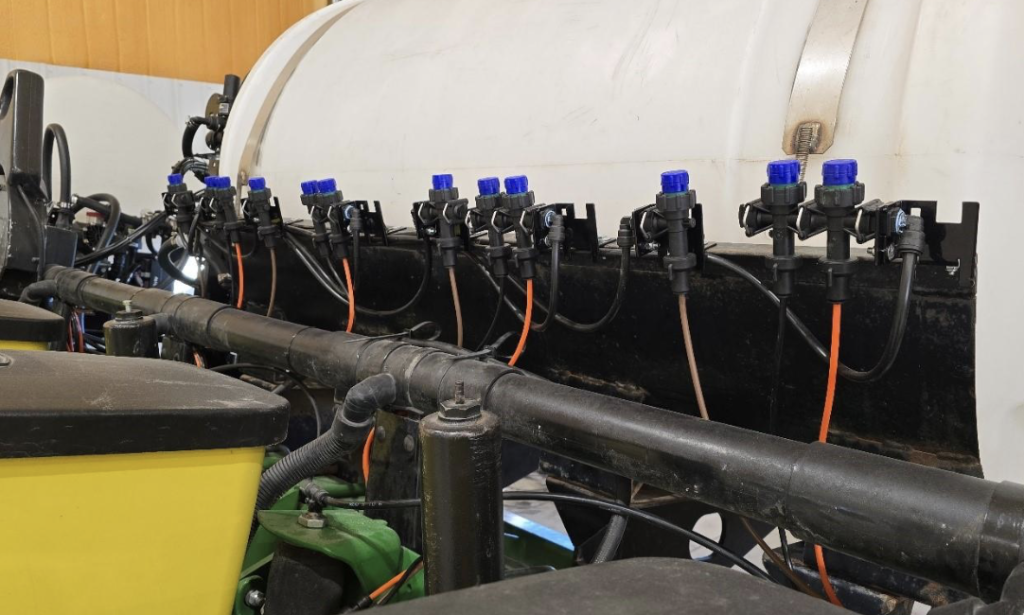
Microtubes over the traditional disk orifice
Every year, we see more and more requests for microtubes over the traditional disk orifice, and for good reason. The microtubes, also known as meter tubes or friction tubes, offer an inside diameter that is at least twice the size of its comparable disk orifice. So of course as more guys are using biological fertilizers or other products such as humic acids, bugs or fish guts, viscous fertilizers, or even just simple 10-34-0 that is dirty, the microtubes are the preferred method of orificing flow at each row.
On top of the larger inside diameter of the microtubes, you can also use larger screens for your filters before your pump. We have had farmers using 30 meshi filters with several different fertilizers with no issues.
The microtubes are very viscosity sensitive, meaning that we need to know the weight per gallon of the fertilizer you are using to ensure we provide you with the correct size tube. Even if the weight is off by 0.2 pounds, that could be enough of a difference to change the needed tube sizes.
All microtubes are cut by AgXcel at 8ft lengths so you don’t have to cut them. And all of our flow rate charts are based off testing with 8ft tubes. The reason why we cut our tubes at 8ft lengths is because that is the optimal length to keep at least a twice as large inside diameter while also being able to maintain a large swath of sizes of tubes. We offer 11 different microtubes sizes. While the inside diameter of the tubes vary, the outside diameter is always 1/4″. So these microtubes can be used with any standard push lock fitting you have.
It is recommended that for each setup, that you would utilize the GX6 setup. The GX6 uses a dual check valve setup that allows the user to select which one of the two microtube sizes that should be used. Since the microtubes are viscosity sensitive, if you start planting in the morning when it’s cooler vs in the afternoon when it’s warmer, then it is possible that you would need to switch tube sizes. Or if you are doing custom work and don’t know what kind of product or rates you will be applying at, then this setup is more versatile and flexible. And instead of pulling off an 8ft dirty tube at each row and then storing it somewhere, now you can just keep that tube on the toolbar and open the microtube size needed on the check valve assembly and close the one not needed. You can also open both check valves to allow flow to travel through both microtubes to apply at an even higher flow rate.
The disk orifices we you are color coded, making identifying them easier. They are also coned shaped, meaning that as flow fits the orifice, the end of the cone that protrudes out faces the flow. So if there were to be any debris in the line, then it would be more likely to move to the side of the orifice vs plugging the hole.

But the disk orifices are better for use with clean, high rate fertilizers such as Nitrogen applications or clean starter fertilizers. Now the advantage of the disk orifice is that they are cheaper than a microtube and take up less room. So if you are applying 32% at 15 GPA, both the microtubes or the disk orifices are a good option. But if you wanted to mix a starter or some kind of bio in your 32%, then the microtubes start to look like a better option.